
What is Ecobricks?
[2022, January 18th, Farrel Arka Hidayat]
Articles
“Eco” and “brick” mean environmentally friendly bricks. Called "brick"
because it can be an alternative to conventional brick in building buildings. Therefore,
eco-bricks are commonly used as raw materials for making furniture. Ecobricks are plastic
bottles filled with non-biological waste to make reusable building blocks. Eco-bricks is a
collaboration-based technology that provides zero-waste solutions for individuals, households,
schools, and communities. Also known as Bottle Brick or Ecoladrillo. This local waste solution
began to be called Ecobrick by a growing community movement around the world.
Many of us
still consume food or any product that is packaged in plastic. Sometimes we try to be creative
and reduce waste by making our soap at home, for example, but the materials used are still
plastic. It's also not easy to just abandon 100% plastic because almost 90% of the products in
supermarkets are already packaged in a package, most of which is plastic packaging.
If reuse and reduction are already very difficult, then eco-bricks are the solution. Ecobricks can give new life to plastic waste. Ecobricks are another way to utilize these wastes other than sending them to landfills (final disposal). With eco-bricks, we have the opportunity to change communities and ecosystems by digesting plastic. We can turn plastic into something that benefits local communities and ecosystems. The characteristics of plastics that are often problematic are longevity and durability, which is something that is sought after.
What are the benefits of Ecobricks?
With eco-bricks, this plastic waste will be stored in a bottle so that
it does not need to be burned, piled up, buried, and so on. Ecobrick technology allows us not to
use plastic in one of the industrial recycling systems, thereby avoiding the biosphere and
saving energy. Ecobricks keep these plastic materials releasing CO2 which will ultimately
contribute to global warming.
Ecobricks are commonly used to make modular furniture, indoor
furniture, garden spaces, green spaces, walls of structures, and buildings such as schools and
houses. Can get ideas from here.
If you are lazy to think about projects and don't want to
bother, nowadays many waste banks accept eco-bricks that can be exchanged for money. In
addition, you can check the drop-off information here.
How to make Ecobricks?
Any plastic bottle can be used to make Eco-brick, but the most appropriate bottles to use are found to be 500 ml. Prepare plastic bottles, non-organic and non-biological waste, scissors, and wood/sticks to compact
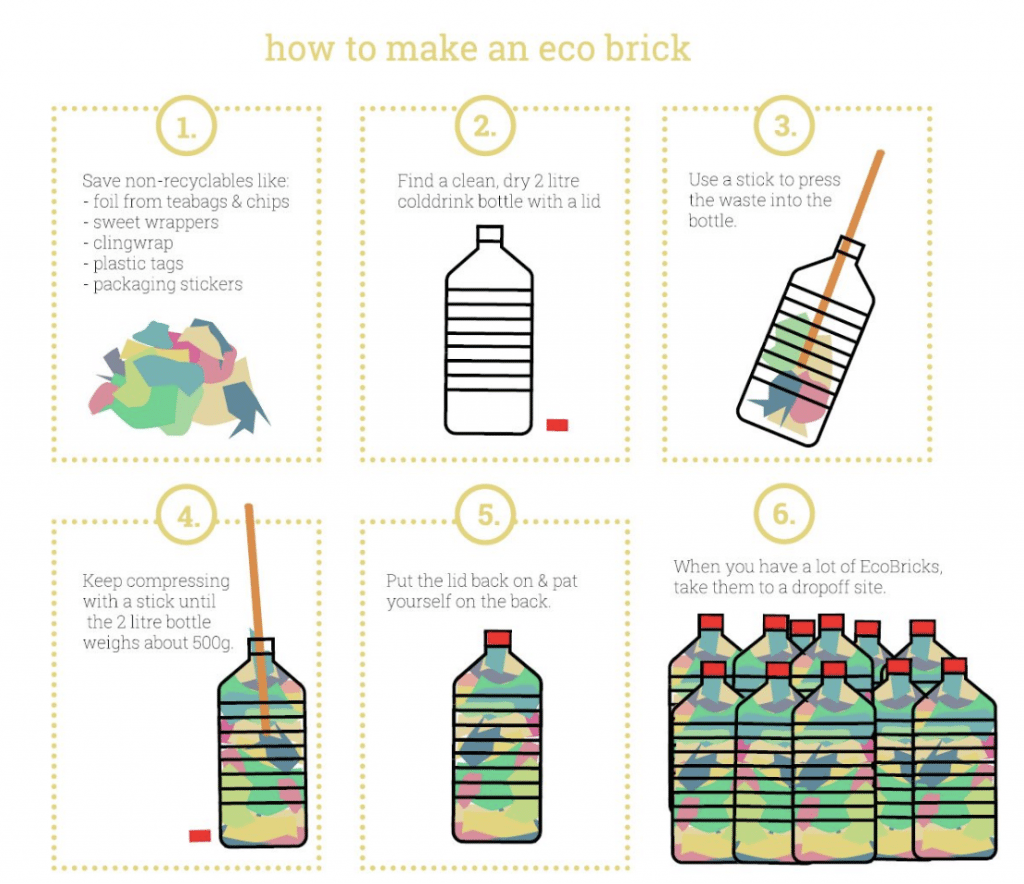
Although it looks easy, in the manufacturing process there are a few
things you need to know
Bottles must be clean and dry
Plastic waste must also be clean
and dry to avoid bacteria growing in the eco brick bottle
Twist and squeeze the wand and
make sure that the filling is solid and evenly distributed throughout the bottle. This helps
ensure that the bottle has no voids and has solid properties similar to that of a concrete
block.
To test the density, we can press the bottle from the outside. A good eco-brick is
when the bottle will not deflate and does not make a sound when pressed.